
Parasites, the Spine, and the Blind Spot in Modern Health
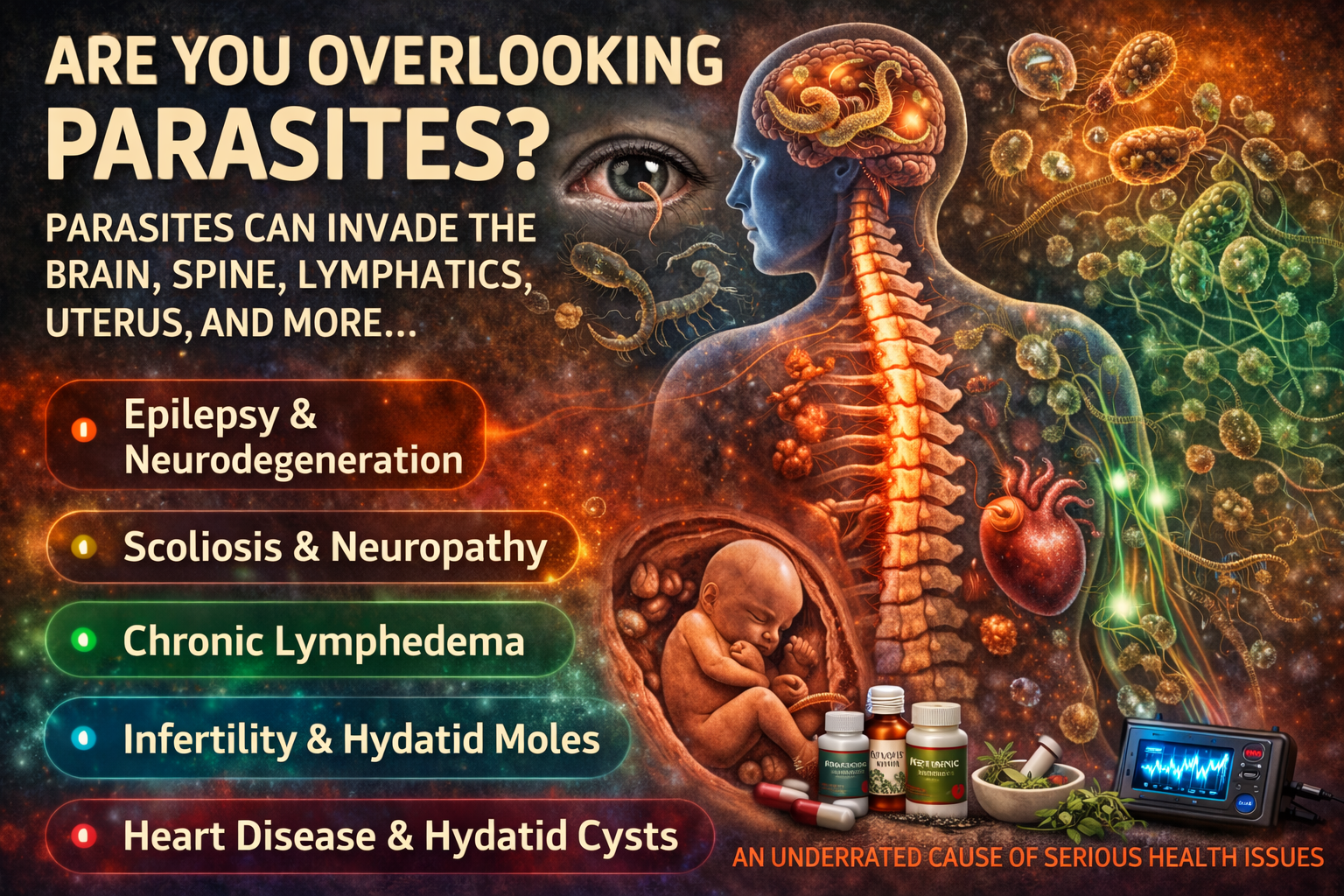
Chronic illness is rarely one-dimensional. This article explores parasites as a commonly overlooked factor in neurological, spinal and systemic health issues, and discusses integrative approaches to restoring balance.
There are topics in health that remain persistently under‑examined; not because they lack relevance, but because they sit outside the comfort zone of modern systems. Parasites are one of those topics.
Despite centuries of documented parasitology, parasites today receive remarkably little attention in everyday clinical practice, at least until they can be seen with the naked eye and by then, it is often too late to do much. At the very least, it is often only the lesser destructive parasites that then get attention. Yet in animals and, increasingly, in humans, there is mounting observational evidence that parasitic burden can sit quietly beneath a wide range of chronic, structural, neurological, and inflammatory conditions.
We have been let down by a system that treats parasites as rare, exotic, or irrelevant - when in reality they may be foundational drivers of ill health.
What Horses Have Taught Us
In orthodox veterinary literature, there is no officially recognised parasite said to “embed into the spine” and directly cause scoliosis in horses. That much is true. Research is sparse, fragmented, and often relegated to post‑mortem findings.
And yet, experience tells a fuller story.
I have personally witnessed 100% correction of scoliosis and stifle lock in horses using a combined approach that included:
targeted anthelmintics (including agents such as fenbendazole and ivermectin)
chiropractic adjustment
Bowen therapy
herbal medicine
infra‑red therapy
acupressure
In these cases, the scoliosis was driven by asymmetrical muscle tone, neurological irritation, and chronic inflammatory signalling. The results included enlarged, painful and assymetrical bone structures. When the underlying irritant was addressed, the body corrected itself.
A spine does not need to be malformed to be crooked. It only needs to be pulled unevenly for long enough.
Certain parasites, particularly migratory or neurotropic species, are known to invade tissue well beyond the gut. In animals, some are capable of entering the central nervous system, creating irritation, inflammation, and unilateral neuromuscular disruption. When this happens near or even within the spinal column, posture and movement are inevitably affected.
Remove the irritant, support the nervous system, restore structural balance and the body often responds decisively.
The Uncomfortable Question for Human Health
If this is observable in horses; large, biomechanically honest animals with no psychosomatic overlay, it raises an uncomfortable question:
Why would humans be exempt from the same?
In humans, scoliosis, chronic back pain, nerve syndromes, pelvic imbalance, and unexplained neurological symptoms are routinely attributed to genetics, degeneration, trauma, or idiopathic causes. Parasites are rarely considered beyond gastrointestinal complaints.
Yet we know that:
parasites can migrate, invade tissue and affect the nervous system
parasites can be microscopic or macroscopic and can persist undetected for years, often only discovered post-mortem
It is not unreasonable to ask whether, once a parasite or parasitic biofilm finds refuge near the spinal column, it becomes difficult to access through pharmaceuticals alone.
This may explain why, in practice, multi‑modal approaches often yield better results:
chiropractic and osteopathic work to restore alignment and circulation
Bowen therapy to reset neuromuscular signalling
infra‑red therapy to improve tissue penetration and immune response
herbal medicine to support terrain and detoxification
Rather than being “adjuncts,” these therapies may be essential access points.
Anthelmintics: A Tool, Not a Taboo
Agents such as fenbendazole and ivermectin have long histories in veterinary medicine and parasitology. Their mechanisms are well understood in animals, yet their broader implications are rarely discussed in human health outside narrow indications, other than within largely private groups dealing with serious health issues outside of modern medicine; taking care of their own health because they have been failed.
Mentioning such tools should not provoke alarm. Nor should it be dismissed.
In observational settings, particularly where parasitic involvement is suspected, addressing parasite load can produce outcomes that no amount of symptom management ever touches.
This is not an argument for reckless or indiscriminate use, but a call to re‑examine a category of medicine that has been sidelined, despite mounting real‑world relevance.
Frequencies, Terrain, and the Overlooked Frontier
Alongside chemical and herbal approaches, I also support the use of frequency‑based parasite therapies (often referred to as zappers). These devices operate on the principle that specific frequencies can disrupt parasitic integrity without harming host tissue.
While this field is poorly funded and under‑researched, it mirrors a broader truth: modern health has become molecule‑obsessed and terrain‑blind.
Parasites do not thrive in isolation. They thrive in compromised, acidic, stressed and malnourished environments.
This is why parasite management should be viewed as routine and essential as detoxification, not as an emergency measure reserved for rare diagnoses, or an over-the-counter once in a lifetime ‘worming’ suggestion.
When You’ve Seen It, You Can’t Unsee It
When you have seen parasites:
in the brain
in the uterus
emerging from eyes and nasal passages
consuming tissue meant to form new life
…it changes you.
To then consider the possibility that parasites may find refuge in the spinal column, quietly influencing posture, nerve function, and structural balance, while almost nothing is being done to investigate it is a reminder to me at least, that we have to consider that there may be dozens, if not hundreds, of possible health issues linked to parasites - and we have to get pro-active.
ALL of us.
Artemis and the Call to Pay Attention
My work with the Artemis blend sits firmly within this context. It is not about fear; it is about responsibility. About recognising that parasites, whether microscopic or visible, remain one of the least addressed factors in chronic illness today.
This is not about rejecting medicine. It is about acknowledging where the system has failed to look.
A gentle reminder, then:
We have been let down.
It is time to bring parasites back into the health conversation, not as an afterthought, but as a foundational consideration.
The body is remarkably capable of correction; when we remove what does not belong there.
I hope you make regular (monthly) parasite treatment a focal point of your health regimen; as important as detoxing, pH balance, nutrition and avoiding harsh chemicals. It just might be the missing link.
OVERLOOKED HUMAN DISORDERS WITH PARASITIC LINKS
Pay attention to the misdiagnoses and symptoms. How many illnesses are there which are being mismanaged, while the use of parasite treatments are overlooked?
🧠 1. Neurocysticercosis
Parasite: Taenia solium (larval stage)
Often misdiagnosed as:
epilepsy
multiple sclerosis
brain tumours
idiopathic seizures
Key facts:
Leading cause of adult-onset epilepsy worldwide
Parasite cysts lodge in brain parenchyma, ventricles, or spinal cord
Can remain dormant for years
Frequently missed in non-endemic countries
🧠 2. Cerebral Toxoplasmosis
Parasite: Toxoplasma gondii
Often reframed as:
psychiatric illness
neurodegeneration
“idiopathic” cognitive decline
Key facts:
Forms cysts in brain tissue
Alters neurotransmitter signalling
Linked to schizophrenia-like symptoms, mood disorders, and behavioural changes
Reactivates under immune stress, pregnancy, or chronic illness
🧬 3. Hydatid Disease / Hydatid Moles
Parasite: Echinococcus granulosus / E. multilocularis
Often misdiagnosed as:
ovarian cysts
liver tumours
lung masses
molar pregnancy anomalies
Key facts:
Produces space-occupying cysts in liver, lungs, brain, uterus
Can mimic cancer radiologically
Rupture can cause anaphylaxis or death
Frequently discovered only during surgery or autopsy
🩸 4. Lymphatic Filariasis
Parasites: Wuchereria bancrofti, Brugia spp.
Often labelled as:
idiopathic lymphedema
chronic fatigue syndromes
autoimmune lymphatic disorders
Key facts:
Adult worms lodge in lymphatic vessels
Causes obstruction, immune dysregulation, chronic inflammation
Subclinical infections may persist without classic elephantiasis
🧠 5. Spinal & Paraspinal Parasitic Migration
Parasites implicated:
Taenia larvae
Schistosoma spp.
Toxocara spp.
Halicephalobus (rare but documented)
Often diagnosed as:
idiopathic scoliosis
radiculopathy
transverse myelitis
unexplained neuropathy
Key facts:
Parasites can lodge in spinal cord, nerve roots, meninges
Diagnosis is often post-mortem
Imaging frequently inconclusive
Inflammation, not mass, causes dysfunction
🫀 6. Chagas Disease (Chronic Phase)
Parasite: Trypanosoma cruzi
Often misdiagnosed as:
idiopathic cardiomyopathy
IBS / megacolon
unexplained arrhythmias
Key facts:
Parasite persists intracellularly for decades
Causes progressive heart and gut damage
Often missed outside Latin America
🧠 7. Visceral Larva Migrans / Neural Larva Migrans
Parasites: Toxocara canis/cati
Often labelled as:
developmental delay
behavioural disorders
idiopathic vision loss
Key facts:
Larvae migrate through organs including brain and eyes
Common exposure, rare diagnosis
Especially relevant in children
🩸 8. Parasitic-Triggered Autoimmune Syndromes
Mechanism: molecular mimicry, immune dysregulation
Often diagnosed as:
lupus
MS
rheumatoid arthritis
Key facts:
Parasites can both suppress and dysregulate immune responses
Some autoimmune presentations resolve partially after antiparasitic therapy
This connection is acknowledged but rarely acted upon clinically
🧠 9. Psychiatric & Neurobehavioral Disorders
Parasites implicated:
Toxoplasma gondii
protozoal co-infections
Associated conditions:
schizophrenia spectrum disorders
risk-taking behaviour
anxiety and depression
Key facts:
Brain cysts influence dopamine pathways
Strong epidemiological correlations exist
Rarely screened in psychiatry
🧬 10. Urogenital & Reproductive Pathology
Parasites: Schistosoma haematobium, Echinococcus
Often misdiagnosed as:
endometriosis
infertility
fibroids
chronic pelvic pain
Key facts:
Parasites lodge in pelvic organs
Can interfere with implantation and fetal development
Linked to miscarriage and pregnancy loss
WHY THESE ARE OVERLOOKED
Western medicine treats parasites as “travel medicine”
Diagnostics are poor unless parasites are actively shedding
Many parasites encyst, migrate, or go dormant
Symptoms are reframed as:
genetic
autoimmune
psychosomatic
idiopathic
Parasites don’t need to be common to be clinically devastating.
They are chronic, migratory, immune-manipulating organisms capable of inhabiting:
brain
spine
lymphatics
uterus
eyes
heart
And they are one of the least routinely considered causes of chronic disease today.
Artemis is a combination of Chrysalis Original’s Helix plus 4 different artemisias -
Artemisia absinthium
Artemisia afra
Artemisia vulgaris
Artemisia cina
- arguably the most effective anthelmintic herbs on earth. Each of these herbs have been successfully used and heavily researched into serious health issues, especially in situations where there seemed to be no other options.
To this, nosodes of hundreds of various parasites are included. Artemis has been used now for 4 decades to help humans and animals alike heal from a wide range of parasitic affectations and their effects.
If you have serious health issues and you are uncertain as to whether Artemis is for you, please send your queries to health@chrysalisoriginal.com or you may want to consider investing in the online consultation.
For Artemis, Find more here.
Research:
I am sure after reading this you might just be feeling a little uncomfortable - and I didn’t even go into the details! Research is very thin on the ground, but it is there, when you know where to look.
🧬 1. Halicephalobus gingivalis — review of equine cases
A comprehensive review summarising reported cases of the free-living nematode Halicephalobus gingivalis infecting horses, including CNS involvement and post-mortem diagnosis. This is a long veterinary review discussing clinical presentations, diagnosis, and phylogeny of the parasite.
📌 Key points:
H. gingivalis occasionally causes opportunistic infections in horses and humans.
Diagnosis is usually post-mortem because the parasite is difficult to detect antemortem.
Many reported equine cases involved neurological signs, and infections are globally distributed.
Peletto S. Halicephalobus gingivalis infection in equids: a review of reported cases, clinical features, and diagnostic challenges. UK Vet Equine. 2024.
🐴 2. Parelaphostrongylus tenuis — confirmed in horse spinal cord
A peer-reviewed case in the Journal of Veterinary Internal Medicine documents a horse with cervical scoliosis and meningomyelitis in which Parelaphostrongylus tenuis (a meningeal worm) was confirmed in the spinal cord via PCR.
📌 Key points:
The article provides molecular confirmation of the parasite in the horse’s cervical spinal cord in association with scoliosis.
Although rare, it supports the idea that parasitic migration in the central nervous system can produce neurological dysfunction and spinal curvature.
Mittelman NS, Divers TJ, Engiles JB, et al. Parelaphostrongylus tenuis cerebrospinal nematodiasis in a horse with cervical scoliosis and meningomyelitis. J Vet Intern Med. 2017;31(3):890–893.
There are additional case reports and veterinary pathology studies documenting Halicephalobus and other parasites in equine tissues, often identified post-mortem (e.g., halicephalobosis in various organs including brain and spinal cord).
Parasitic and zoonotic meningoencephalitis in humans and equids: current knowledge and the role of Halicephalobus gingivalis. PubMed.